
Cultivating Community at St. Michael Food Bank Garden
/Bouquets displayed at the Snohomish Community Food Bank.
Nestled on the grounds of St. Michael Catholic Church in Snohomish, there’s a flourishing garden that’s been supporting the Snohomish Community Food Bank since 2009.
Just last summer, the garden produced over 3,500 pounds of fresh vegetables and nearly 1,000 bouquets of flowers.
What started with a handful of volunteers has grown into a gathering of dedicated gardeners, largely from St. Michael Catholic Church. Each summer on Tuesday and Friday mornings, volunteers come together to plant, tend, and harvest, turning what was once a lawn into a thriving source of organic food and flowers.
Financial support from the Snohomish Conservation District has played an important role in the garden’s continued progress.
In 2022, a $500 cost-share grant from the District helped fund supplies for an automated drip irrigation system, cutting down volunteer watering time and conserving water while delivering it more efficiently to plants. In 2025, a $500 Lawns-to-Lettuce mini-grant paid for seeds and row covers to protect crops, helping ensure the garden continues to thrive.
Sustainability is at the heart of the garden. By avoiding tilling or digging, volunteers preserve the soil’s natural structure, creating healthy conditions for plant roots, microbes, and other beneficial organisms.
Cover crops are planted in late summer to continue improving soil health. In the fall, parishioners drop off bagged leaves, which are composted or used as mulch for next year’s crops. Along the borders, native Washington wildflowers support pollinators and add beauty to the space.
Planting the winter cover crop.
Pole bean harvest (with bunny protection at base).
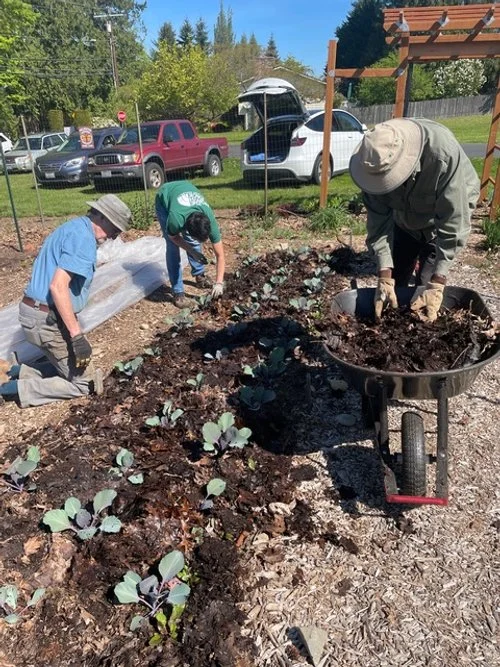
Volunteers mulch one of the cabbage beds with compost made from parishioner-donated leaves.
Volunteers track weekly yields, try new crops, and repeat what works best. A 4’ x 25’ bed typically produces at least 100 pounds, often more when multiple crops are planted in a season—for example, an early crop of cabbage can be followed by carrots, beets, or bush beans that yield another 50–100 pounds.
Over the years, the garden has evolved. When a tree began shading some of the vegetable beds, volunteers converted the section to grow flowers. Combined with blooms from volunteers’ personal gardens, St. Michael Catholic Church now delivers nearly 30 bouquets semi-weekly to the Food Bank, where they have become one of the most desired items for clients, alongside the fresh vegetables.
Social engagement is a large part of the garden’s success. Up to 20 volunteers gather each week, forming friendships while working toward a shared goal of supporting the community. Since 2009, their efforts have steadily increased vegetable production, introduced flower bouquets, improved soil, and supported wildlife—strengthened along the way by support from Snohomish Conservation District.
Cabbage harvest begins while more corn is planted in another bed.
A volunteer plants Swiss chard alongside pole beans.
The volunteer Flower Team makes bouquets.
